
CAU English Education 11 Youn-ah Kim
2012년 10월 31일 수요일


2012년 10월 29일 월요일
week 8-1) Class Activities
•CALL Tool Demo 1: Voice Thread
https://voicethread.com/share/3610240/
•CALL Tool Demo 2: Reddit (EFL comics)
http://ragemaker.net/
2012년 10월 27일 토요일
Discussion Questions 6
•From communicative language teaching (CLT) perspective, writing practice should be interactive. Discuss how English teachers can provide interactive English writing experience for students.
These days English teachers can use internet to provide natural environment where students can write and communicate interactively.There are a lots of examples that a teacher give students some assignments: to write some essay, reply to their friends' essay, discuss about some issues on-line and etc. Teachers can provide various on-line activities related to interactive writing.
•When we write for authentic purposes, there are always audience (except secret diaries or self-notes). Discuss types of writing activities for different audiences.
In writing, an audience is an important consideration. Especially in school settings, the concept of audience may not be clearly defined on a writing assignment. There are many various audiences, and also diverse types of writing activities for different audiences. For examples, writing a letter to English teacher, the Author of a Story, families, and friends is a great activity. Also students can write email and post something their blog or twitter; there are a lot of on-line writing activities and wider audiences such as key pal, peer, institution, and people all over the world. The audience of 'The Writing Portfolio-audience', 'Providing an Alternative Ending', 'An Introduction to an Anthology of Short Stories' is everybody, wider audiences.
•How does technology help task-based writing? Discuss and write your ideas on your blog.
Teachers can provide opportunities to write English in internet. Writing and sending E-mail, writing diaries or posting their writings on their blog or twitter is also great activities. These activities can help students effectively improve their English skills, because students can use authentic language, not fixed English and also can receive quick responses from others.
2012년 10월 17일 수요일
week 7-2) Class Activities
CMC


Benefits of CMC
Cultural aspect
- Big Culture- BigC : History, Historical Something we can learn in the texts book
- Little Culture-Little C : Body Languages, Food, ets. Something we can't learn easily in the texts book
Pegagogical Features of CMC

Tools for Speaking
1. Sound/Sound Pattern
•talking dictionary Howjsay http://www.howjsay.com/ Word pronunciation
•English Pronunciation (By New Okanagan college) http://international.ouc.bc.ca/pronunciation/ consonant vowel syllable, minimal pairs, interactive exercise
•American English Pronunciation (By Manythings.org) http://www.manythings.org/pp/
•Tongue Twister 1 (alphabetically sorted) 2 (for Kids British council, videos) 3 (EFL Playhouse, alphabetically sorted)
2. Role Play/Drill/Sentence Level
•Voki http://www.voki.com
•Alicebot http://www.pandorabots.com/pandora/talk?botid=f5d922d97e345aa1
•Practice Speaking with Mike (Talkingbot) http://www.eslfast.com/robot/tutor_mike.htm
•Text-to-Speech from Oddcast http://www.oddcast.com/home/demos/tts/tts_example.php
•Go animate http://goanimate.com/
3. Discussion/conferencing
•Online talk group -http://www.voxopop.com/
•Voice Thread http://voicethread.com/
•Google Voice http://www.google.com/chat/voice/


☞CALL review 2☜
Professor Kim displayed multiple online tools and resources for listening to us. On my blog, I posted activities which I enjoyed in last class, so you can check very useful CALL listening resources or programs if you click on the hyperlink here. http://younahing.blogspot.kr/2012/09/week5-1-class-activities.html

Manything's listening activities http://www.manythings.org/e/listening.html


Secondly, in 'American Stories (Text & MP3 Files)' part, there are listening files about American stories which are very various, popular and interesting stories such as The Last Leaf. Like first part, we can listen easily funny stories just by simply clicking 'play' button.


The strengths of this CALL resource are countless. First, we can use very various listening materials such as numerous English stories, interesting quizzes, etc. We do not have to waste of time to find listening files, reading materials separately. We can gain two things (reading materials & audio files) at a time. Also we can make our EFL students not to be bored and uninteresting to listening, because there are many activities we can provide. We do not provide just one way to listen, so student may be interesting to those ways. As a English teacher, we can make the best use of this CALL resource in listening class.


Manything's listening activities http://www.manythings.org/e/listening.html
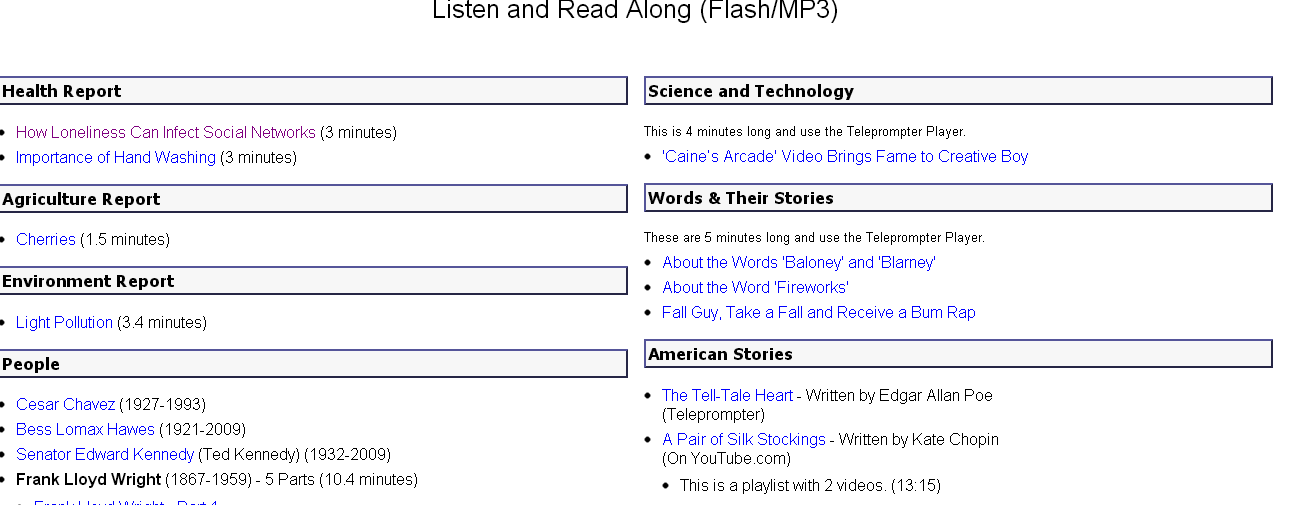
My favorite resource among a lots of online listening tools is Manything's listening activities http://www.manythings.org/e/listening.html. This homepage provides us many interesting things for ESL Students. As you can see, there are 5 parts 'Listen and Read Along','American
Stories (Text & MP3 Files)', 'English
Listening Room', 'Listen and Answer', and 'Dictation Quiz'.
Firstly in 'Listen and Read Along' part, there are various reading materials which can be offered with sound (flash or MP3). We can listen native pronunciation reading sentences one by one just by simply clicking 'play' button.


Third function in 'English Listening Room' is about listening cloze quizzes. There are cloze quizzes we can solve by listening and filling the blanks at the same time. If you fill in the all blanks and click 'Check Answers', you can find out what you write correctly and incorrectly.


Finally, in 'Listen and Answer' and 'Dictation Quiz'. we can enjoy and learn English by some questions such as dictations, T/F questions or multiple choices questions. We can solve the these questions with listening the English and check the answer easily.


The strengths of this CALL resource are countless. First, we can use very various listening materials such as numerous English stories, interesting quizzes, etc. We do not have to waste of time to find listening files, reading materials separately. We can gain two things (reading materials & audio files) at a time. Also we can make our EFL students not to be bored and uninteresting to listening, because there are many activities we can provide. We do not provide just one way to listen, so student may be interesting to those ways. As a English teacher, we can make the best use of this CALL resource in listening class.
Secondly students can listen and get some information at the same time. In 'Listen and Read Along' part, there are various reading materials which can be offered with sound. And these materials convey informational content of interest and relevance to the learner. So this content- based listening have the potential of increasing intrinsic motivation and empowerment.
However, this CALL resource also have some weaknesses, I think some quizzes which can answered by typing have some problems. They can not recognize the differences between upper and lower cases and type-off. If this CALL supplement some typing processes or a proper way to correct wrong answers, it will become a better useful site.
Finally I think this CALL is very useful and motivating tool for English learners. If I will be a English teacher, I use this effective site for my future students.
However, this CALL resource also have some weaknesses, I think some quizzes which can answered by typing have some problems. They can not recognize the differences between upper and lower cases and type-off. If this CALL supplement some typing processes or a proper way to correct wrong answers, it will become a better useful site.
Other weakness is about no division of level or proficiency. Many learners have different level, and Each man has a proficiency of his own. However in this CALL most listening materials are in same level. So if there are some separation, we can enjoy and utilize this CALL resource more usefully. If the site take some advises into consideration and try to change some defaults it has, then it will become a better useful site for all kinds of English learners around the world.
Finally I think this CALL is very useful and motivating tool for English learners. If I will be a English teacher, I use this effective site for my future students.
Week 7-1) Class Activites
Teaching speaking
1.sound/soundpattern
2.words(not only single word)
3.sentences
4.fluency
5.communicative practices(culture discourse)
Asynchronous CMC
1.blogging coment
2.discussion board=BBS
3.E-mail
4.SNS(facebook, twitter,etc.)
Synchoronous CMC
1.chat room
2.conferencing
3.instant messengers
2012년 10월 15일 월요일
Discussion Questions 6) Speaking approaches
- What aspects of language does "speaking" include? In another word, what do you have to teach in order to successfully develop an English speaking ability?
- Discuss speaking approaches that you have read. What are familiar or unfamiliar to you? What activities have you experienced for your school years?
- What is CMC? Discuss the characteristics of CMC from L2 pedagogic perspective.
- How does CMC help foreign language learning?
With CMC in L2, teachers can encourage a greater amount of interactions by using CMC tools both inside and outside the classroom. Learning is no longer restrained in time and space, through the internet, learners are offered opportunities to communicate and learn collaboratively with learners worldwide. EFL learners do not need to passively listen to audio tapes alone after class; through the use of the internet and CMC tools they can easily participate in more interactions by posting and replying messages on discussion boards, writing and replying emails to their key-pals or joining online chat rooms whenever suitable. Learning becomes a 24 hour process. This new way of learning that engages learners in authentic social interactions can greatly expose learners to the TL and enable them to practice what they have learned in the classroom.
피드 구독하기:
글 (Atom)